
NGX Fear and Greed Index: What Market Sentiment Tells Nigerian Investors
A composite sentiment indicator built from real NGX data, covering market breadth, ASI momentum, volume trends, and sector breadth. How to read it and what to do with the signal.
The Market Has a Mood, and It Moves Your Money
On April 2, 2026, the NGX Fear and Greed Index read 36. Fear. Only 40 stocks advanced while 66 declined. Trading volume sat at 53% of its 20-day average. Just 1 of 13 sectors posted positive breadth. The numbers painted a clear picture: sellers controlled the market, and most participants had stepped aside.
An investor checking only the ASI headline would have missed this. The All-Share Index can rise on heavy buying in three or four mega-caps, DANGCEM, MTNN, AIRTELAFRI, while the broad market quietly bleeds. The reverse happens too: a modest ASI dip can mask a rally across dozens of smaller names. Headline numbers flatten the texture of what actually happened on the trading floor.
Most Nigerian retail investors lack a structured way to read this texture. Trading decisions flow from broker tips, WhatsApp group chatter, and gut instinct. These inputs are not useless, but they are unstructured. A sentiment index condenses multiple market signals into a single number that answers one question: is the overall market leaning toward fear or greed right now?
That reading does not tell you what to buy. It tells you what environment you are buying into, and that distinction matters more than most investors realise.
What a Fear and Greed Index Measures
CNN popularised the concept for US markets. Their Fear and Greed Index tracks seven components: market momentum, stock price strength, stock price breadth, put-call options ratio, junk bond demand, VIX volatility, and safe haven demand. Each is normalised to a 0–100 scale and equally weighted. The composite score produces a single reading from Extreme Fear to Extreme Greed.
The idea rests on a well-observed pattern: markets overshoot in both directions. When fear dominates, prices fall below what fundamentals justify because selling begets more selling. When greed takes hold, prices stretch above fair value because buying attracts more buying. Sentiment extremes do not predict reversals on a specific day, but they have historically coincided with turning points. Research published in 2024 found that CNN's index showed statistically significant predictive power on S&P 500 returns from 2011 to 2020, though the relationship weakened in the 2021–2024 period.
The concept applies to any market with sufficient data. Nigeria's challenge has been that no one built one for the NGX, until now.
How the NGX Version Works: Four Components, Real Data
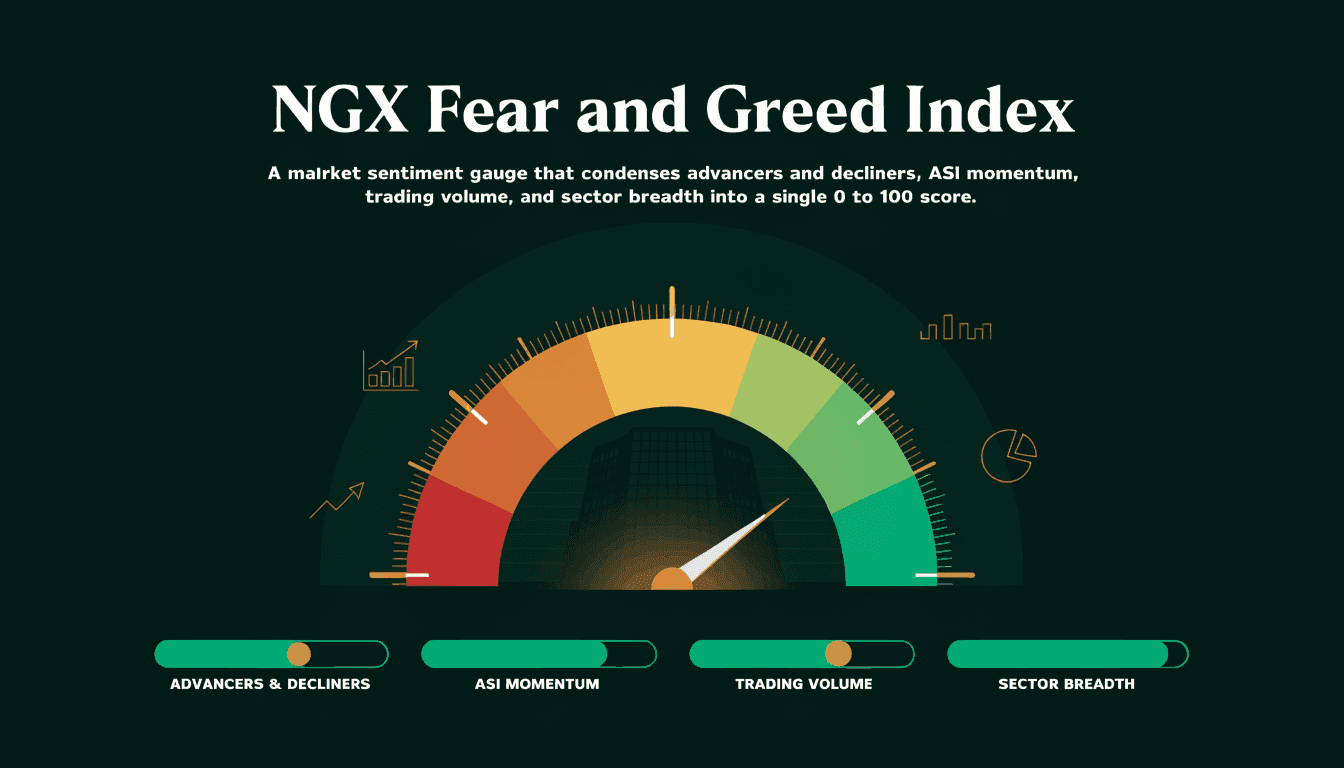
Journaira's NGX Fear and Greed Index uses live data from the Nigerian Exchange Group. It is not an adaptation of CNN's model or an import of US signals. The components were chosen for what is measurable and meaningful on the NGX, where instruments like put-call ratios and junk bond spreads do not exist.
Four components, weighted by their signal reliability:
| Component | Weight | What It Measures | Data Source |
|---|---|---|---|
| Market Breadth | 40% | Advancers vs decliners | Daily NGX closing prices |
| ASI Momentum | 30% | Short-term (5-day) and medium-term (20-day) price trend | NGX All-Share Index values |
| Volume Trend | 20% | Current trading volume vs 20-day average | Daily NGX volume data |
| Sector Breadth | 10% | Proportion of sectors with more advancers than decliners | NGX sector-level stock data |
The composite score falls on a 0–100 scale:
| Score | Label | What It Suggests |
|---|---|---|
| 0–19 | Extreme Fear | Broad selling pressure, potential buying opportunity |
| 20–39 | Fear | Market pessimism, caution prevails |
| 40–59 | Neutral | Balanced sentiment, no strong directional signal |
| 60–79 | Greed | Optimism rising, momentum favours buyers |
| 80–100 | Extreme Greed | Euphoria, potential caution warranted |
A Worked Example
Consider the data from April 2, 2026. Here is how the composite score of 36 was calculated:
Market Breadth (40% weight): 40 stocks advanced, 66 declined. The breadth score equals advancers divided by total movers: 40 / (40 + 66) = 37.7, which rounds to 38. Multiply by the 40% weight: 38 x 0.40 = 15.2 points.
ASI Momentum (30% weight): The ASI gained 0.4% over 5 days but showed 0.0% change over 20 days. The 5-day figure converts to a score of 52 on the 0–100 scale (a 10% gain would map to 100, a 10% loss to 0). The 20-day figure converts to 50 (neutral). The blended momentum score, weighted 60/40 between short and medium term, comes to 51. Multiply by 30%: 51 x 0.30 = 15.3 points.
Volume Trend (20% weight): Trading volume ran at 53% of the 20-day average. The score equals the volume ratio multiplied by 50, giving 0.53 x 50 = 26. Multiply by 20%: 26 x 0.20 = 5.2 points.
Sector Breadth (10% weight): Only 1 of 13 sectors had more advancers than decliners. Score: (1/13) x 100 = 8. Multiply by 10%: 8 x 0.10 = 0.8 points.
Composite: 15.2 + 15.3 + 5.2 + 0.8 = 36.5, rounded to 36. Sentiment label: Fear.
The breakdown reveals something the composite number alone does not: ASI momentum was actually neutral (51), while volume and sector breadth dragged the overall reading deep into fear territory. The selling was broad but not panicked, and the headline index had not collapsed. This kind of divergence between components carries more information than the single number.
Reading the Components: What Each Signal Tells You
Market Breadth: The Width of the Move
Market Breadth carries 40% of the index weight because it answers the most fundamental question about any market move: how many stocks are participating?
A rising ASI driven by heavy buying in DANGCEM, MTNN, and BUACEMENT while 60 other stocks decline is a qualitatively different market from one where 80 stocks advance and 30 decline. The first scenario reflects concentrated institutional flows. The second reflects broad conviction. Both can produce the same ASI return on the day, but the breadth signal distinguishes between them.
When breadth diverges from the ASI direction, pay attention. A rising index with narrowing breadth, fewer stocks participating in each successive rally, has preceded several NGX pullbacks. The ASI's 51% gain in 2025, as covered in our sector performance analysis, was broad enough to sustain itself. Narrow rallies tend not to last.
ASI Momentum: Speed and Direction
This component blends two timeframes. The 5-day momentum (weighted at 60%) captures the short-term trajectory: is the market accelerating, decelerating, or flat? The 20-day momentum (40%) captures the medium-term trend.
When both timeframes agree, the signal is strong. When they diverge, the market may be at an inflection point. A positive 5-day reading with a negative 20-day reading suggests a bounce within a broader downtrend. A negative 5-day reading with a positive 20-day reading suggests a pullback within a broader uptrend. Neither pattern tells you what happens next, but both tell you to look more carefully before acting.
The scoring maps percentage changes onto a 0–100 scale where a 10% gain over the period equals 100 and a 10% loss equals 0. This calibration reflects NGX volatility, where the ASI rarely moves more than 10% in a 5 or 20-day window. A score of 51, as seen on April 2, means the ASI was roughly flat over both periods.
Volume Trend: Market Conviction
Volume measures participation. A rally on high volume carries more weight than one on thin trading, because more participants are putting money behind the move. The same logic applies to selloffs: heavy-volume declines signal genuine liquidation, while low-volume dips may reflect nothing more than an absence of buyers.
The score compares the current day's total volume to the 20-day average. A ratio of 1.0 (average volume) maps to a score of 50. A ratio of 2.0 (double average) maps to 100. On April 2, volume sat at 53% of average, producing a score of 26. When volume drops this low, it suggests most market participants are watching from the sidelines, neither buying aggressively nor selling in panic.
Low volume during a fear reading tells a different story than high volume during fear. High-volume fear suggests capitulation, the kind of washout that sometimes precedes a reversal. Low-volume fear suggests apathy, a market drifting lower without conviction in either direction. The distinction matters for timing entries.
Sector Breadth: How Wide Is the Pain?
Sector Breadth carries the smallest weight (10%) because it is the coarsest signal, but it adds a dimension the other components miss. When 1 of 13 sectors is positive, as on April 2, the selling pressure spans the entire market. When 10 of 13 sectors are positive but the ASI is flat, the market's strength is real but concentrated losses in a few large-cap sectors are masking it.
This component counts each sector as a binary signal: positive (more advancers than decliners) or negative. It does not weight by sector market capitalisation, so the Banking sector and the Insurance sector each count equally despite their vastly different sizes. This is deliberate. The signal measures how widespread optimism or pessimism is, not how much money it represents.
How to Use Sentiment Without Becoming a Contrarian Cliche
"Buy when others are fearful" is one of the most quoted and least followed pieces of investment advice. The sentiment index tempts a simplistic interpretation: see Extreme Fear, buy everything. This approach fails more often than it succeeds because fear is sometimes justified. Stocks fall because earnings collapse, because regulatory environments shift, because currency devaluations destroy real returns.
Sentiment is a context tool, not a timing signal. Here are three ways to use it practically:
1. Confirm or Question Your Thesis
Suppose Chidi has been watching GTCO and believes the stock is undervalued based on its price-to-book ratio and dividend yield. He checks the sentiment index and finds it at 22, Extreme Fear. This does not automatically validate his thesis, but it tells him two things: he is buying against the crowd (which means he needs to be right about the fundamentals, not just the sentiment), and if his thesis is correct, he may be getting a better entry price than he would during a neutral or greedy market.
If the index reads 85, Extreme Greed, and Chidi still wants to buy GTCO, the signal does not say "don't buy." It says "you are buying into a market where optimism is stretched." He might consider a smaller initial position, or he might set a lower limit price and wait for a pullback.
2. Size Your Positions
Funke manages a ₦15,000,000 portfolio and typically allocates 10–15% per position. During periods of high greed (60+), she reduces her standard allocation to 7–10%. During periods of fear (below 40), she considers increasing to 15–20% for high-conviction names. The sentiment reading does not change her stock selection, but it adjusts how much she is willing to commit at a given price level.
| Sentiment Level | Suggested Position Sizing | Reasoning |
|---|---|---|
| Extreme Fear (0–19) | Larger than normal for high-conviction picks | Broad pessimism may offer discounted entry points |
| Fear (20–39) | Normal to slightly larger | Pessimism provides some margin of safety |
| Neutral (40–59) | Normal allocation | No strong directional signal |
| Greed (60–79) | Slightly smaller than normal | Optimism reduces margin of safety |
| Extreme Greed (80–100) | Smaller positions, tighter risk management | Euphoria increases downside risk |
3. Track Your Own Emotions
This may be the most valuable application. Record the Fear and Greed Index reading alongside every trade in your journal. After a few months, review: did you tend to buy during greed and sell during fear? Most retail traders do, and this pattern is the primary reason roughly 70% of them lose money.
The sentiment index externalises what is otherwise invisible. "I felt good about the market" becomes "the index was at 74, and I bought." Seeing that pattern in your own data, repeatedly buying near sentiment peaks and selling near troughs, is more persuasive than any article telling you to do the opposite.
How Journaira Helps
The NGX Fear and Greed Index lives in the Research section under the Market Sentiment tab. It updates daily using real NGX market data.
Three features make it more than a single number:
Historical comparison cards show how the current reading compares to the previous close, one week ago, and one month ago. A reading of 36 today that was 49 a week ago and 54 a month ago tells a different story than a 36 that was 32 a week ago and 28 a month ago. The first is deteriorating sentiment; the second is stabilising.
Component breakdown shows the score and progress bar for each of the four factors, with their weights displayed. When the composite reads "Fear" but ASI Momentum scores 51 (neutral), you know the fear is driven by breadth and volume, not by a falling index. This granularity helps you decide whether the fear is the kind you want to buy into or the kind you want to respect.
Trade journal integration lets you cross-reference your trading decisions with the prevailing market sentiment. Over time, this reveals whether your buying and selling patterns align with crowd behaviour or diverge from it, and which approach has produced better results for your specific strategy.
The Bottom Line
Markets move on fundamentals and sentiment. Ignoring either gives you an incomplete picture. The NGX Fear and Greed Index provides a structured, data-driven reading of aggregate market mood, built from four signals that are specific to the Nigerian Exchange and updated from real trading data.
It will not tell you what to buy. It will tell you what kind of market you are buying into. For an investor managing a portfolio of Nigerian equities, that context shapes every decision from position sizing to entry timing to the simple question of whether today is a day to act or a day to watch.
Check the current sentiment reading before your next trade.
This article is for educational purposes only and does not constitute financial advice. Investment decisions should be based on your individual circumstances, risk tolerance, and consultation with a qualified financial adviser. Past performance, whether nominal or inflation-adjusted, is not indicative of future results.