
Why Every Nigerian Trader Needs a Trading Journal
Most Nigerian traders track profits but not process. A trading journal reveals the patterns behind your wins and losses — and it might be the one habit that separates consistent traders from everyone else.

The Habit Most Nigerian Traders Skip
Roughly 70% of retail traders lose money in any given quarter. Of those who try day trading, only about 1.6% manage to be consistently profitable over the course of a year. These are not Nigerian-specific figures, they hold across markets globally, but they point to something important: the vast majority of people who trade stocks are not making money, and most of them do not know exactly why.
The Nigerian market is booming. Between January and May 2025, 151,749 new brokerage accounts were opened in Nigeria, and retail investment through the first seven months of that year reached ₦981 billion, a 56% increase year-on-year. More Nigerians are trading than ever before. But a growing number of participants does not automatically translate into a growing number of successful participants.
What separates the small minority who consistently profit from the majority who do not? There are many factors (knowledge, discipline, risk management, market conditions) but one of the most overlooked is remarkably simple: keeping a trading journal.
Not a trade log. Not a portfolio summary. A journal. The distinction matters, and understanding it might be the most valuable thing you read today.
What Exactly Is a Trading Journal?
Most brokers provide some form of trade history: a list of what you bought, when you bought it, the price, and whether you made or lost money. That is a trade log. It records the facts. It tells you what happened.
A trading journal goes further. It records why things happened. Why did you enter that trade? What was your plan? What was the market doing at the time? How were you feeling? Did you follow your strategy, or did you deviate? What did you learn?
The difference is not trivial. A trade log is a receipt. A journal is a diagnostic tool.
| Trade Log | Trading Journal | |
|---|---|---|
| What it records | Transactions: date, symbol, price, quantity | Transactions plus context, reasoning, and reflection |
| Entry detail | Buy DANGCEM at ₦450, sell at ₦520 | Bought DANGCEM at ₦450 based on breakout above 200-day MA; plan was to sell at ₦530 or stop at ₦420 |
| Exit detail | Sold for ₦70 profit per share | Sold at ₦520 (below target) due to sector-wide sell-off; lesson: set trailing stop earlier |
| Emotional context | None | Felt anxious after previous loss, may have exited too early |
| Strategic value | Tells you your P&L | Tells you why your P&L looks the way it does |
The journal is where raw data becomes insight. Without it, you are flying blind. You know your results but not the process that produced them.
What a Journal Reveals About Your Trading
A journal that captures both the numbers and the reasoning behind them can surface patterns you would never spot from a trade log alone. Here are some of the most common, and most valuable, insights.
Your Real Win Rate
Most traders overestimate how often they are right. This is not a character flaw; it is a well-documented cognitive bias. We remember our winners more vividly than our losers, and we tend to round up when estimating our success rate.
A journal forces precision. When you record every trade and its outcome, your actual win rate emerges, and it is often lower than you expected. A trader who believes they win 60% of the time may discover the real figure is closer to 42%. That is not a reason to stop trading. It is the starting point for improvement, because you cannot fix what you have not measured.
The Disposition Effect
In 1998, the economist Terrance Odean published research showing that investors are far more likely to sell winning positions too early and hold losing positions too long. He called this the disposition effect, and it costs the average investor an estimated 4.4% in annual returns.
The logic is psychological. Selling a winner feels good. You lock in a gain, you feel validated. Holding a loser lets you avoid the pain of admitting a mistake. But this behaviour is the exact opposite of what a disciplined strategy demands. Good trading means letting winners run and cutting losers short.
A journal makes the disposition effect visible. When you track your holding periods, you might discover that you hold losing positions for an average of 47 days but winners for only 15. That asymmetry is costing you money, and without a journal, you would likely never notice it.
Your Best and Worst Sectors
The Nigerian Exchange has 13 sectors, from banking and insurance to oil and gas, consumer goods, and industrial goods. Most Nigerian retail traders concentrate their activity in a handful of familiar names like the big banks, Dangote Cement, and MTN Nigeria, without systematically tracking which sectors actually generate their best returns.
A journal with sector tags on each trade lets you run a simple analysis: what is your win rate in banking stocks versus oil and gas? What is your average return in consumer goods versus industrials? The answers can be surprising. You might find that your gut feeling about which sectors suit your style does not match the data at all.
Emotional Trading Triggers
Revenge trading, placing an impulsive trade immediately after a loss in an attempt to recover, is one of the most destructive patterns in retail trading. So is FOMO-driven buying, often triggered in the Nigerian market by tips circulating in WhatsApp groups.
A journal that captures your emotional state at the time of each trade creates a record you can review dispassionately. When you notice that your worst monthly performance coincided with a cluster of trades tagged "revenge" or "WhatsApp tip", the pattern becomes impossible to ignore.
The Cost of Deviating from Your Plan
Perhaps the most powerful insight a journal provides is the performance gap between trades where you followed your plan and trades where you did not. If your planned entries have a 48% win rate but your impulsive entries have a 29% win rate, the journal has just told you exactly how much your deviation from discipline is costing you. That kind of clarity is rare, and it only comes from consistent record-keeping.
The Nigerian Trading Context
While the benefits of journaling apply to traders everywhere, several features of the Nigerian market make it especially valuable here.
Compressed Trading Hours
The NGX operates from 10:00 AM to 2:20 PM WAT, just over four hours. Compare this to the 6.5-hour US session or the 8.5-hour London session. Nigerian traders make decisions in a compressed window, which leaves less time for deliberation during the trading day itself.
This makes post-session review critical. A journal gives you a structured way to analyse the decisions you made under time pressure, identify mistakes, and prepare for the next session. The traders who sit down for 15 minutes after market close to record their observations are the ones who compound their learning over time.
The WhatsApp Group Effect
About 70% of new Nigerian brokerage accounts are opened through digital brokers, and many of these new investors are heavily influenced by social media and messaging group tips. WhatsApp groups, Telegram channels, and Twitter (X) accounts promoting "hot stocks" are a defining feature of the Nigerian retail trading landscape.
There is nothing inherently wrong with considering ideas from other sources. The problem arises when traders follow tips blindly without tracking whether those tips actually perform. A journal lets you tag trades by source (your own analysis versus a group tip) and measure the results objectively. Many traders who do this exercise discover that their own research outperforms the group tips by a significant margin.
Tax Compliance Under the 2025 Finance Act
The 2025 Finance Act introduced a dual threshold system for Capital Gains Tax on securities. The 30% CGT rate applies when both of the following thresholds are exceeded:
- Proceeds Threshold: ₦150,000,000 in total disposal proceeds over a rolling 12-month window
- Gains Threshold: ₦10,000,000 in net capital gains within the calendar year
For active traders, staying aware of your running position against these thresholds is not optional; it is a compliance requirement. The Federal Inland Revenue Service (FIRS) expects taxpayers to maintain adequate records of their transactions. A trading journal that tracks proceeds and gains alongside your performance data serves double duty: it makes you a better trader and keeps you on the right side of the tax code.
Inflation Erosion
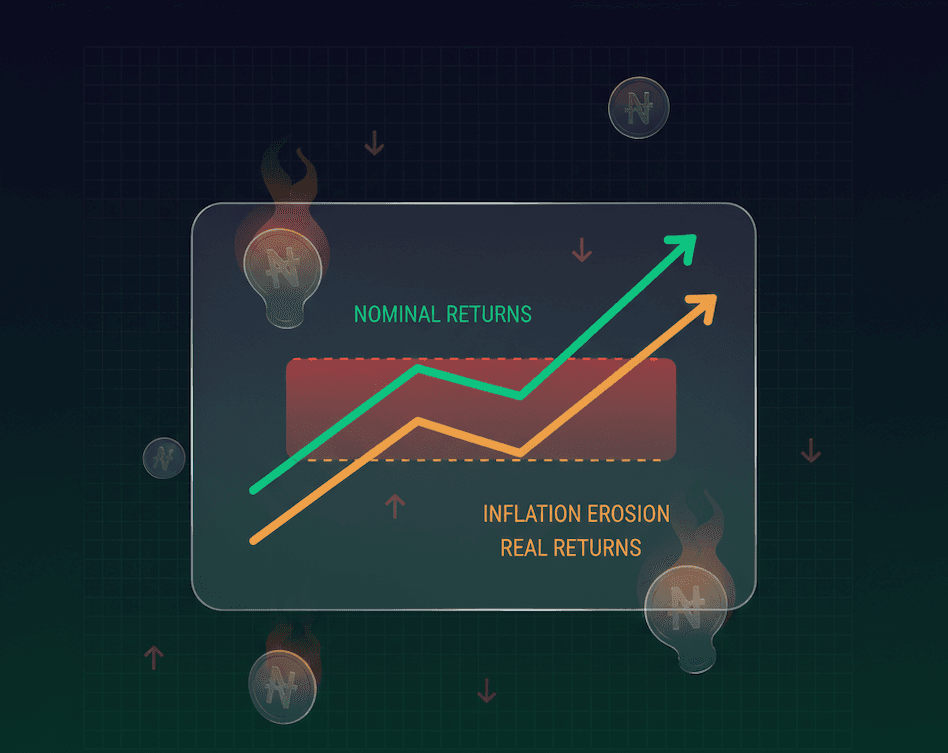
Nigeria's headline inflation rate stood at 15.10% in January 2026. This means that a 20% nominal return on your portfolio translates to a real return of approximately 4.3% after adjusting for inflation. Without tracking your real returns, you risk overestimating how much wealth your trading is actually creating.
A journal that incorporates inflation-adjusted performance gives you an honest picture. That "great year" where you returned 18% looks very different when you realise inflation was 24%, your purchasing power actually declined. Traders who track real returns make better allocation decisions because they are working with accurate data.
What to Record in Your Journal
If you are convinced that journaling is worth the effort, the next question is practical: what exactly should you record?
Essential Fields
These are the minimum data points for every trade.
| Field | Description | Example |
|---|---|---|
| Date | Trade execution date | 2026-02-15 |
| Symbol | Ticker or stock name | GTCO |
| Direction | Buy or sell | Buy |
| Quantity | Number of shares | 5,000 |
| Entry Price | Price paid per share | ₦42.50 |
| Exit Price | Price received per share | ₦48.00 |
| Gross P&L | Profit or loss before fees | ₦27,500 |
| Holding Period | Days between entry and exit | 23 days |
Recommended Additional Fields
These fields are where the journal becomes more than a glorified trade log.
| Field | Why It Matters |
|---|---|
| Strategy Tag | Categorise each trade (breakout, momentum, dividend capture, etc.) to measure strategy-level performance |
| Entry Reason | What prompted the trade — forces you to articulate your thesis before entering |
| Exit Reason | Why you closed — target hit, stop triggered, thesis invalidated, emotional decision |
| Trade Plan | Your intended entry, target, and stop before execution — reveals plan adherence |
| Emotional State | Calm, anxious, excited, frustrated — patterns between emotion and outcome become visible |
| Setup Quality | Rate 1-5 before entering — compare outcomes by conviction level |
| Lessons Learned | One sentence after each trade — compounds into a personal knowledge base |
A brief note on Nigerian-specific costs: remember to account for the transaction fees that apply to every NGX trade. These include the SEC fee (0.3% on buys), the NGX fee (0.3% on sells), the CSCS fee (0.3% on sells), stamp duty (0.075%), and VAT at 7.5% on commissions. These fees affect your net returns and should be factored into your P&L calculations.
The Spreadsheet Problem
Most traders who attempt journaling start with a spreadsheet. It seems like the obvious choice. Excel or Google Sheets is free, flexible, and familiar. And for the first few weeks, it works well enough.
The problems emerge over time.
Manual data entry is tedious and error-prone. If you make 200 or more trades in a year, entering each one by hand, with all the additional fields a good journal requires, becomes a chore. Chores get abandoned. A study of trading journal adoption found that most spreadsheet-based journals are abandoned within three months.
No inflation adjustment. Tracking real returns in a spreadsheet means manually looking up NBS inflation data and building your own formulas. Most traders do not bother, which means they are evaluating their performance with incomplete information.
No tax threshold tracking. Monitoring your position against the ₦150M proceeds and ₦10M gains thresholds requires running calculations across your entire trade history. In a spreadsheet, this is possible but cumbersome, and errors have real financial consequences.
No FIFO cost basis automation. Nigerian CGT is calculated using the First In, First Out method. If you have multiple lots of the same stock purchased at different prices, calculating your cost basis manually for each sale is slow and prone to mistakes.
It does not scale. A spreadsheet that works for 50 trades buckles under 500. Formulas break, the file becomes slow, and cross-referencing data across multiple sheets turns into a maintenance project of its own.
The spreadsheet is where good intentions go to stall. It is better than nothing, but barely.
From Journal to Edge: The Improvement Timeline
If journaling is so powerful, how long does it take to see results? Research by Dr. Brett Steenbarger and other trading psychology practitioners suggests a general timeline.
Months 1-2: Awareness. The simple act of recording your trades creates immediate discipline. You think twice before entering a trade when you know you will have to write down your reason. Many traders report a reduction in impulsive trades within the first few weeks, simply because the journal holds them accountable.
Months 3-4: Pattern recognition. With two to three months of data, patterns begin to emerge. You notice that your win rate varies dramatically by sector, or that your Monday trades consistently underperform, or that you tend to overtrade on days when you are stressed. These are not theoretical insights. They are specific, actionable observations drawn from your own data.
Months 5-6: Behavioural change. Armed with pattern data, you begin allocating more capital to strategies and sectors where you have proven strength, and reducing exposure where you have proven weakness. You start recognising emotional triggers in real time because you have seen them in your journal entries.
Months 7 and beyond: Compounding improvement. Over time, the journal becomes a personal trading playbook, a record of what works for you specifically, built on hundreds of data points from your own experience. Practitioner evidence suggests that traders who maintain consistent journals see win rate improvements in the range of 22% to 45% over the first year.
The timeline is not magic. It requires honest, consistent recording and regular review. But the improvement curve is real, and it compounds.
Chinedu's First Three Months
Let us look at a practical example. Chinedu is a Lagos-based trader who opened a brokerage account in late 2025. He trades NGX equities two or three times per week, mostly in banking and oil and gas stocks. Like most new traders, he has a rough sense that he is "doing okay" but no precise data to back it up.
In January 2026, he starts keeping a journal.
Month 1: The wake-up call. Chinedu discovers his actual win rate is 38%. He had estimated it at roughly 55%. He also notices that he holds losing positions for an average of 34 days but closes winners after just 11 days, a textbook disposition effect that is costing him real money.
Month 2: Sector clarity. With enough data to compare, Chinedu finds that his banking sector trades have a 51% win rate with an average return of +8.3%, while his oil and gas trades have a 31% win rate with an average return of -4.1%. He had been splitting his capital roughly evenly between the two sectors without realising one was consistently dragging his portfolio down.
Month 3: Source analysis. Chinedu tagged each trade by source: his own research or a WhatsApp group tip. The results are stark. His own analysis has a 52% win rate. The WhatsApp tips have a 28% win rate. He had been giving equal weight to both sources without any data to justify it.
| Metric | Before Journal | After 3 Months |
|---|---|---|
| Perceived win rate | ~55% | Actual: 38% → Improving to 44% |
| Avg. holding period (losers) | Unknown | 34 days → 19 days (cutting losses faster) |
| Sector allocation | 50/50 banking vs oil | 70/30 favouring banking |
| WhatsApp tip reliance | Frequent | Reduced sharply |
| Monthly review habit | None | Weekly 15-minute review |
Chinedu is not a different trader after three months. He has the same knowledge, the same capital, the same market access. But he is making decisions based on data instead of intuition, and his results are beginning to reflect that shift.
How Journaira Makes This Easy
Journaira was built specifically for Nigerian traders who want the benefits of journaling without the friction of maintaining a manual system.
Automatic Trade Import
Instead of entering trades by hand, you can import your trade history directly from your broker. Journaira supports CSV and PDF statements from Nigerian brokers including Stanbic IBTC, Bamboo, CardinalStone, Chapel Hill Denham, Morgan Capital, and a generic format that covers most other firms. With 191 registered NGX brokers in the database, the platform is designed to work with the Nigerian market as it actually exists.
Built-In Journaling Fields
Every trade in Journaira includes fields for notes, entry reason, exit reason, trade plan, and strategy tags. These are not buried in a separate module. They are part of the core trade record, available every time you review a position. The journal is not an afterthought; it is central to the product.
Performance Analytics
Journaira calculates your win rate, profit factor, Sharpe ratio, sector breakdown, holding period analysis, and benchmark comparison against the NGX All-Share Index, all automatically, from your imported data. You do not need to build formulas or maintain pivot tables. The analytics update as you add trades.
Inflation-Adjusted Returns
With a single toggle, you can switch between nominal returns and real returns adjusted for inflation using live data from the National Bureau of Statistics. This is not a minor feature in a country where double-digit inflation can turn an apparent profit into a real loss. Journaira also provides break-even analysis adjusted for inflation, so you know exactly how much your investments need to return just to maintain purchasing power.
Tax Threshold Tracking
Journaira tracks your running position against both the ₦150,000,000 proceeds threshold and the ₦10,000,000 gains threshold in real time, with dual visual meters on your dashboard. A tax-loss harvesting wizard identifies opportunities to offset gains, and a scenario simulator lets you model the tax impact of potential trades before you execute them.
Getting Started
If you have read this far and are convinced that a trading journal is worth maintaining, here are five practical steps.
-
Start today, not Monday. The most common reason traders never start journaling is that they are waiting for the "right time." There is no right time. Open your next trade with a written entry reason and you have begun.
-
Import your history. Most brokers can provide a CSV or PDF statement of your past trades. Importing that history gives you an immediate baseline to analyse. You do not need to wait months before you have useful data.
-
Record every trade going forward, especially the bad ones. The losing trades are where the most valuable lessons live. It is tempting to skip logging a trade you are embarrassed about. Resist that temptation. The journal is for you, not for anyone else.
-
Review weekly. Set aside 15 minutes at the end of each week to review your journal. Look for patterns in your entries. Which trades followed your plan? Which did not? What was your emotional state during your best and worst trades? This weekly review is where journaling converts from record-keeping into genuine improvement.
-
Be honest. A journal filled with flattering narratives about why every trade was "basically right" is useless. The value comes from candour. When you deviated from your plan, say so. When you made an emotional decision, record it. The journal works only if it reflects reality.
The Bottom Line
The cost of not journaling is invisible, which is precisely why most traders never address it. You do not see the patterns you are missing, the biases you are repeating, or the sectors you are over-allocating to. The losses compound quietly, disguised as "bad luck" or "the market being unpredictable."
A trading journal does not guarantee success. Nothing does. But it gives you something that most retail traders lack: a systematic, honest record of your own decision-making. Over time, that record becomes the foundation for genuine improvement — not because the market changed, but because you did.
The traders who track their process, not just their profits, are the ones who compound their edge. In a market where 70% of participants lose money, having an edge is not a luxury. It is a necessity.
This article is for educational purposes only and does not constitute financial advice. Investment decisions should be based on your individual circumstances, risk tolerance, and consultation with a qualified financial adviser. Past performance is not indicative of future results. Statistics cited are from publicly available research and are used for illustrative purposes.