
Nigerian Stock Brokers Compared: A 2026 Guide for Investors
An honest comparison of Nigeria's top stock brokers — fees, platforms, customer support, and which ones let you import trades into a journal automatically.

Why Your Choice of Broker Matters
Nigeria has over 191 registered stockbrokers with the Nigerian Exchange Group (NGX), yet the vast majority of retail investors concentrate their trading activity through a small handful of firms. Your choice of broker affects everything from the commissions eating into your returns, to the quality of trade statements you receive at tax time, to whether you can actually reach someone when something goes wrong with an order.
For many Nigerian investors, selecting a broker is an afterthought: they sign up with whichever firm a colleague recommends or whichever app they encounter first. But as your portfolio grows and you begin thinking seriously about performance tracking, capital gains tax obligations, and long-term wealth building, the differences between brokers become material.
This guide offers a practical, balanced comparison of some of Nigeria's most widely used stockbroking firms. It is not a recommendation or endorsement of any specific broker. Fees, features, and service quality change over time, so always verify current details directly with the broker before making a decision.
What to Look For in a Nigerian Broker
Before diving into specific firms, it helps to understand the criteria that matter most when evaluating a broker in the Nigerian market.
Fees and Commissions
Brokerage commissions on the NGX typically range from 0.5% to 1.5% of trade value, though this varies by broker, trade size, and whether you are buying or selling. Some brokers charge a flat minimum fee per transaction, while others bundle regulatory levies (SEC fees, NGX fees, CSCS fees) into a single quoted rate. Always ask for a full breakdown, not just the headline commission rate.
Platform Usability
Some brokers offer sleek mobile apps with real-time quotes and instant order execution. Others still rely on phone calls and email instructions. If you intend to trade actively, the quality of the trading platform matters a great deal. If you are a buy-and-hold investor, a less sophisticated platform may be perfectly adequate.
Customer Support
This is often the most underrated factor. When a trade fails to execute, when your dividend credit is delayed, or when you need a corrected trade statement, responsive customer support saves time and stress. Test a broker's responsiveness before committing significant capital.
Trade Statement Format
This is particularly relevant for investors who track their performance or need to file capital gains tax returns. Some brokers provide clean CSV exports that can be imported directly into tracking tools. Others issue PDF statements that require more effort to process. A few still rely on scanned documents or manual summaries that are difficult to work with at all.
Mobile App Quality
A large proportion of Nigerian investors trade primarily from their mobile phones. App stability, speed on slower network connections, and an intuitive interface are not luxuries; they are necessities for the Nigerian market.
Research and Tools
Some brokers provide daily market commentary, sector analysis, and stock recommendations. Others offer almost no research. If you are newer to investing or want professional analysis to complement your own, this is worth considering.
Minimum Deposit
Account opening requirements vary. Some fintech brokers allow you to start with as little as a few thousand naira, whilst traditional brokers may require higher initial deposits or minimum trade sizes.
Top Brokers Overview
The following table summarises six widely used Nigerian stockbroking firms. Each has a different strengths, and none is objectively "the best"; the right choice depends on your individual needs.
| Broker | Type | Market Access | Strengths | Best For |
|---|---|---|---|---|
| Stanbic IBTC Stockbroking | Bank-backed | NGX | Established reputation, strong research, institutional credibility | Investors who value research and banking integration |
| Bamboo | Fintech | NGX + US markets | Excellent mobile app, low entry barrier, fractional US shares | Mobile-first investors, dual-market access |
| Chaka | Fintech | NGX + US markets | Modern interface, dual-market access, regulated by SEC | Tech-savvy investors wanting local and international exposure |
| CardinalStone | Traditional | NGX | Strong institutional presence, detailed research reports | Serious investors who value in-depth analysis |
| Meristem Stockbrokers | Traditional | NGX | Well-established, full-service advisory | Long-term investors, HNW individuals |
| ARM Securities | Asset management | NGX | Asset management expertise, conservative approach | Long-term wealth builders, retirement-focused investors |
Stanbic IBTC Stockbroking
As part of the Stanbic IBTC banking group, this broker benefits from significant institutional backing and a long track record on the NGX. They offer research reports and market commentary that many retail investors find valuable. The platform is functional, though it does not have the modern feel of newer fintech apps. For investors who already bank with Stanbic IBTC, the integration between banking and brokerage accounts is a convenience.
Bamboo (Invest Bamboo)
Bamboo has become one of the most popular trading platforms in Nigeria, particularly among younger investors. Their mobile app is well-designed and performs reasonably well even on mid-range devices. Bamboo provides access to both Nigerian and US equities, allowing investors to buy fractional shares of American stocks alongside NGX-listed companies. The low barrier to entry, you can start with a small amount, has made it a common first broker for new investors.
Chaka
Like Bamboo, Chaka offers dual-market access covering both the NGX and US equities. Chaka is regulated by the SEC and has positioned itself as a modern, technology-driven alternative to traditional brokers. The app is clean and intuitive, and they have been expanding their product offerings steadily. For investors who want a single platform for both local and international stocks, Chaka is a strong contender.
CardinalStone
CardinalStone maintains a significant institutional and advisory presence. Their research team produces detailed reports on Nigerian equities and sectors, which can be valuable for investors who take a fundamental analysis approach. They cater to both retail and institutional clients, and their platform reflects a more traditional brokerage experience. If quality research is a priority for you, CardinalStone is worth considering.
Meristem Stockbrokers
Meristem is one of Nigeria's well-established broking firms with a reputation for professionalism and advisory services. They tend to attract more experienced investors and those with larger portfolios who benefit from personalised advisory. Their platform is functional and they provide reasonably detailed trade statements. Meristem is a solid choice for investors who want a traditional, full-service experience.
ARM Securities
ARM Securities operates within the broader ARM (Asset & Resource Management) group, which is one of Nigeria's leading asset management firms. Their strength lies in long-term wealth management and structured investment products rather than active trading. If your approach is long-term and you value a conservative, managed strategy, ARM's broader ecosystem of mutual funds and investment products may complement a brokerage account well.
Fee Comparison
Brokerage fees in Nigeria are not always straightforward to compare. The total cost of a trade typically includes the broker's commission plus regulatory levies (SEC, NGX, and CSCS fees). Some brokers quote an all-in rate, while others list their commission separately from levies.
Important note: The figures below are approximate ranges based on publicly available information at the time of writing. Fees change frequently, and brokers may offer different rates based on trade size, account type, or promotional periods. Always confirm current fees directly with the broker.
| Broker | Commission Range | Minimum Fee | Account Opening | Platform Fee | Notable |
|---|---|---|---|---|---|
| Stanbic IBTC | Typically 1-1.5% | Varies | Generally free | Included | All-in pricing common |
| Bamboo | Varies by market | Low | Free | Free | US trades may have different fee structure |
| Chaka | Varies by market | Low | Free | Free | Competitive rates for both markets |
| CardinalStone | Typically 1-1.5% | Varies | Generally free | Included | May negotiate for larger accounts |
| Meristem | Typically 1-1.5% | Varies | Generally free | Included | Advisory fees may apply separately |
| ARM Securities | Typically 1-1.5% | Varies | Generally free | Included | Asset management fees separate |
Beyond the commission, remember to account for the SEC fee (currently a small percentage of trade value), the NGX fee, and the CSCS fee for settlement. These regulatory charges apply regardless of which broker you use, though the total amount is relatively small compared to the brokerage commission itself.
For active traders, even small differences in commission rates add up over hundreds of trades. A difference of 0.25% on a ₦1,000,000 trade is ₦2,500, which adds up quickly over a year of regular trading.
Trade Statement Formats
This is a topic that does not receive enough attention in most broker comparisons, but it matters enormously for anyone who takes performance tracking or tax compliance seriously.
When you need to review your trading history, calculate your capital gains, or import your trades into a tracking tool, the format of your trade statement determines how much effort is involved.
| Broker | CSV Export | PDF Statements | Statement Quality |
|---|---|---|---|
| Stanbic IBTC | Limited | Yes | Generally well-structured PDFs |
| Bamboo | Yes | Yes | Good digital exports from the app |
| Chaka | Yes | Yes | Clean format, app-based access |
| CardinalStone | Limited | Yes | Detailed but often PDF-only |
| Meristem | Limited | Yes | Standard broker statement format |
| ARM Securities | Limited | Yes | Standard format |
CSV exports are the gold standard for data portability. They can be opened in spreadsheets, imported into tracking tools, and processed programmatically. If your broker provides clean CSV files with consistent column formatting, tracking your trades becomes much easier.
PDF statements are more common among traditional brokers. While they are human-readable, extracting structured data from PDFs requires either manual transcription or specialised parsing tools.
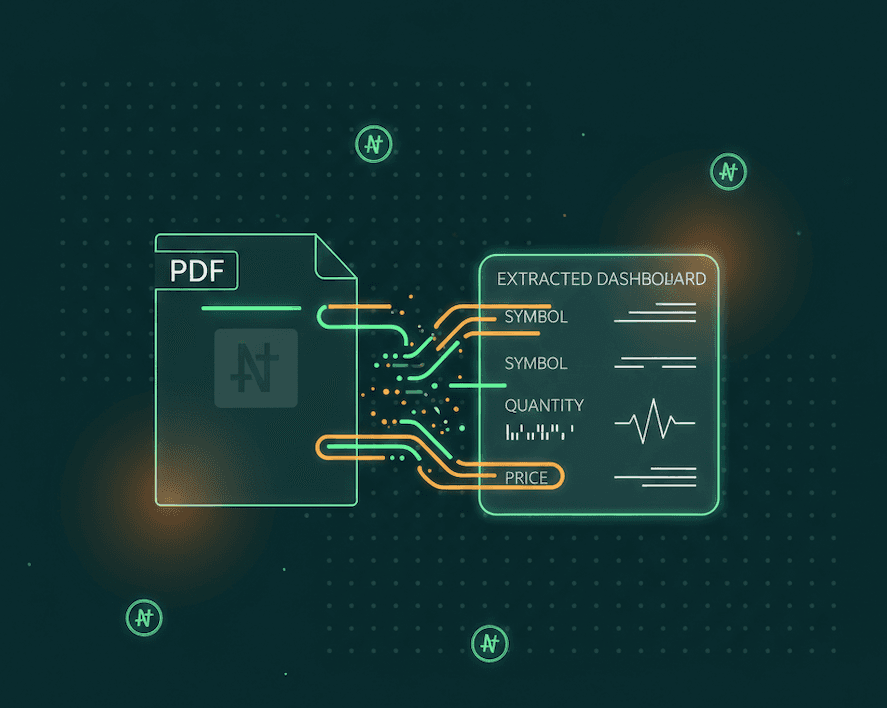
Journaira supports importing trades from multiple Nigerian broker formats, including both CSV and PDF statements. If your broker provides PDFs, Journaira can parse the most common statement layouts and extract your trade data automatically. This means you are not locked into a broker solely because of their export format, though brokers with clean CSV exports do make the process smoother.
Mobile App Experience
Given that a significant proportion of Nigerian investors access the markets primarily through their smartphones, the quality of a broker's mobile application is a practical concern, not a cosmetic one.
Bamboo and Chaka have invested heavily in their mobile experiences. Both apps are designed mobile-first, with intuitive navigation, quick order execution, and portfolio views that work well on smaller screens. They also tend to perform reasonably on the 3G and 4G connections that are still common across Nigeria, which is an important consideration outside major cities.
Stanbic IBTC has a mobile platform, though it reflects the bank's broader digital infrastructure rather than a purpose-built trading app. It is functional, but the experience is not as polished as the fintech alternatives.
CardinalStone, Meristem, and ARM Securities offer varying levels of mobile access. Some provide mobile-responsive web portals rather than dedicated apps. If mobile trading is a priority, it is worth testing the actual app experience before committing: download the app, explore the interface, and assess whether it meets your expectations.
For investors who primarily use desktop or prefer placing orders via their relationship manager, the mobile app may be less important. But for the growing majority who manage their investments from their phone, this is a decisive factor.
How to Switch Brokers
If you are already with a broker and considering a switch, the process in Nigeria is more straightforward than many investors assume. Your shares are held centrally by the Central Securities Clearing System (CSCS), not by your individual broker. This means your holdings are portable.
The general process for transferring your account:
- Open an account with your new broker. Complete their KYC requirements and account documentation.
- Request a transfer by filling out a CSCS transfer form (sometimes called an inter-broker transfer form). Your new broker can usually provide this.
- Both brokers process the transfer through the CSCS system. Your old broker releases the holdings and your new broker receives them.
- Verify your holdings with the new broker once the transfer is complete.
The transfer typically takes a few business days to a couple of weeks, depending on how promptly both brokers act. During the transfer period, you may not be able to trade the specific securities being moved, so plan accordingly.
One important note: switching brokers does not change your CSCS account or CHN (Clearing House Number). Your CHN stays with you regardless of which broker you use, and your historical records at the CSCS remain intact.
How Journaira Complements Your Broker
It is worth clarifying what Journaira is and is not. Journaira is not a broker. We do not execute trades, hold your securities, or manage your money. Journaira is a trading journal and analytics platform designed specifically for the Nigerian market.
Journaira works alongside whichever broker you choose by solving problems that brokers themselves typically do not address:
- Performance tracking — See your actual returns over time, including win rates, average holding periods, and sector allocation breakdowns. Most brokers show you your current portfolio value but not detailed performance analytics.
- Inflation-adjusted returns — Nigeria's inflation rate means that nominal returns often paint an incomplete picture. Journaira shows your real returns using live NBS inflation data, so you can see whether your investments are genuinely growing your purchasing power.
- Tax reporting — Under the 2025 Finance Act, capital gains tax obligations depend on dual thresholds (a ₦150,000,000 proceeds threshold and a ₦10,000,000 gains threshold). Journaira tracks your position against both thresholds and supports FIFO cost basis calculations, making tax season considerably less stressful.
- Multi-broker consolidation — If you use more than one broker (which is common for investors who trade both NGX and US equities), Journaira gives you a single view of your combined portfolio and performance.
You can import your trade history from supported brokers via CSV or PDF statements. The import process is designed to be straightforward: upload your statement file, confirm the parsed trades, and your data is available for analysis immediately.
Making Your Decision
There is no single "best" broker for every Nigerian investor. The right choice depends on your trading frequency, the markets you want to access, how much you value research and advisory services, and practical considerations like mobile app quality and statement formats.
Here is a simple framework:
- If you want dual-market access (NGX + US) and a modern mobile experience: look at Bamboo or Chaka.
- If you value institutional backing and research: consider Stanbic IBTC or CardinalStone.
- If you prefer full-service advisory: Meristem is worth exploring.
- If your focus is long-term wealth management: ARM Securities may suit your approach.
Whichever broker you choose, the most important thing is to actually track and review your trading activity. A good journal, whether it is a spreadsheet, a notebook, or a dedicated tool like Journaira, turns raw trades into actionable insights.
Disclaimer: This article is for informational purposes only and does not constitute financial advice or a recommendation of any specific broker. Fee structures, platform features, and service quality can change at any time. Always conduct your own research and verify current details directly with the broker before opening an account. Journaira has no financial relationship with any of the brokers mentioned in this article.