

Real Returns After Inflation: What Nigerian Investors Actually Earn
Your portfolio shows 25% gains, but after inflation your real return might be just 5%. Learn how to calculate inflation-adjusted returns and why it matters for Nigerian investors.
Your Portfolio Is Lying to You
Your brokerage statement says your portfolio returned 25% last year. Congratulations. That sounds like a solid year. But here is the uncomfortable question: did your money actually grow?
In Nigeria, where inflation has consistently run in the double digits, the number on your screen can be deeply misleading. That 25% gain might translate to barely any increase in what your money can actually buy. A loaf of bread that cost ₦1,500 last year now costs ₦1,800. The fuel you put in your car, the rice on your table, the school fees you pay — everything has moved. If your portfolio did not outpace those price increases, you have effectively lost ground while thinking you were winning.
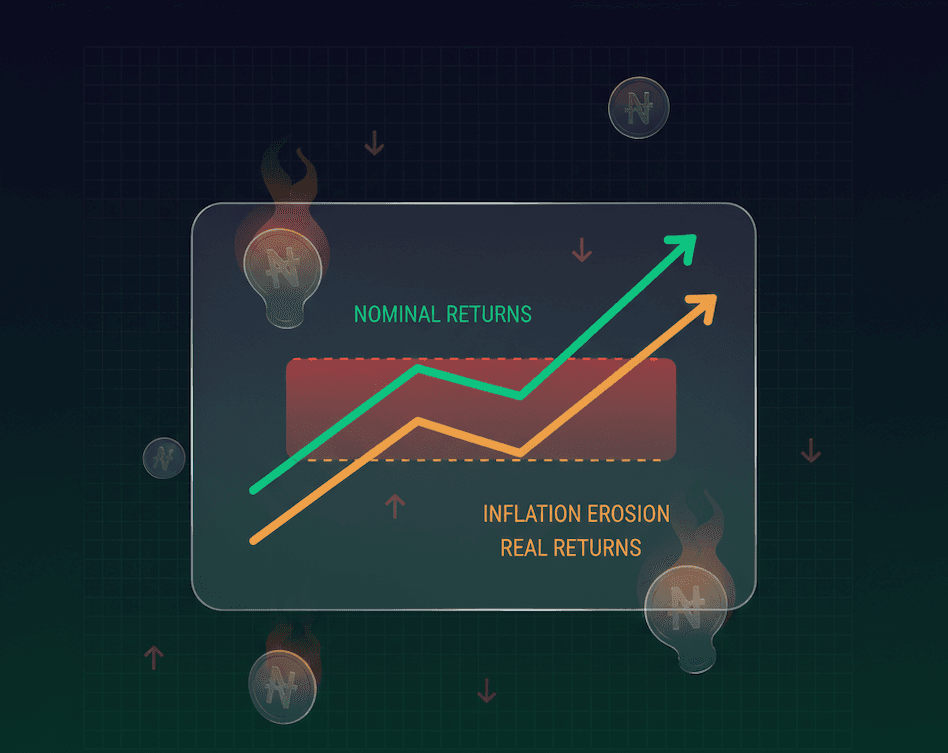
This is the difference between nominal returns and real returns, and understanding it is one of the most important things any Nigerian investor can do.
Nominal vs Real Returns: What Is the Difference?
Nominal return is the raw percentage gain or loss on your investment. It is the number your broker reports, the figure you see in your portfolio summary. If you invested ₦10,000,000 and it grew to ₦12,500,000, your nominal return is 25%.
Real return is what remains after you account for inflation. It measures the change in your actual purchasing power: how much more (or less) you can buy with your money compared to when you first invested it.
Think of it this way. Suppose you put ₦1,000 in a savings account at the start of the year. By December, you have ₦1,100, a 10% nominal return. But if a loaf of bread cost ₦500 in January and ₦600 in December (a 20% increase), your ₦1,000 used to buy two loaves. Your ₦1,100 now buys only 1.83 loaves. Despite your account balance going up, you can afford less bread than before. Your real return was negative.
This is not an abstract concept in Nigeria. It is the lived experience of millions of savers and investors.
Nigeria's Inflation Reality
Nigeria has been in a persistent high-inflation environment for years. The National Bureau of Statistics (NBS), the official source of inflation data in the country, has recorded headline inflation rates that would alarm investors in most developed markets.
In 2023, Nigeria's year-on-year inflation rate climbed past 28%, driven by the removal of fuel subsidies and the unification of the naira exchange rate. Throughout 2024 and into 2025, rates remained stubbornly in the 20-30% range, with food inflation, which hits everyday Nigerians hardest, running even higher than the headline figure.
To put this in context: if inflation is running at 25% annually, your investments need to return more than 25% just to break even in real terms. Anything less and you are losing purchasing power, regardless of what your portfolio statement says.
This is a different reality from the situation faced by investors in low-inflation economies. A British investor earning 8% when inflation is 3% has a comfortable real return. A Nigerian investor earning 20% when inflation is 25% is actually going backwards.
The Formula for Real Returns
The precise formula for calculating real return is:
Real Return = ((1 + Nominal Return) / (1 + Inflation Rate)) - 1
You might see a simpler approximation floating around: just subtract inflation from your nominal return. That works roughly when both numbers are small, but with the kind of inflation rates Nigeria experiences, the approximation becomes unreliable. Always use the full formula.
Let us work through a quick example. If your nominal return is 15% and inflation is 10%:
- Real Return = ((1 + 0.15) / (1 + 0.10)) - 1
- Real Return = (1.15 / 1.10) - 1
- Real Return = 1.0455 - 1
- Real Return = 0.0455, or about 4.55%
Notice that the real return is not simply 15% minus 10% = 5%. The actual figure is slightly lower at 4.55%. This difference becomes much more pronounced at higher inflation rates.
A Worked Example: The ₦10 Million Portfolio
Let us look at a scenario that many Nigerian investors will find familiar.
Adeola invested ₦10,000,000 across a mix of NGX equities and fixed income instruments at the start of the year. By December, her portfolio is worth ₦12,500,000. Her broker's year-end report proudly displays a 25% return. She is pleased. It was a good year, or so it seems.
But the NBS reported a headline inflation rate of 22% for the same period. Let us apply the formula:
- Nominal Return: 25% (0.25)
- Inflation Rate: 22% (0.22)
- Real Return = ((1 + 0.25) / (1 + 0.22)) - 1
- Real Return = (1.25 / 1.22) - 1
- Real Return = 1.0246 - 1
- Real Return = 0.0246, or approximately 2.5%
Adeola gained ₦2,500,000 on paper. But in terms of what that money can actually purchase, her real gain is closer to ₦250,000. The other ₦2,250,000 of her "profit" was simply keeping pace with rising prices.
If she had earned less than 22%, she would have been losing purchasing power despite seeing a positive number in her portfolio. An investor who earned 15% in the same period, a return that sounds perfectly respectable, would have a real return of roughly -5.7%. They would have lost nearly six percent of their purchasing power while believing they were making money.
Why This Matters Especially for Nigerian Investors
Several factors make inflation-adjusted thinking particularly critical for investors in Nigeria.
The Naira's Structural Weakness
The naira has been on a long-term depreciating trend against major currencies. When the naira weakens, import costs rise, and since Nigeria depends heavily on imports for everything from refined fuel to consumer electronics, this feeds directly into domestic inflation. Your portfolio might look healthy in naira terms while actually shrinking relative to the cost of the goods and services you consume.
Food Inflation Runs Ahead of Headline Numbers
The NBS headline inflation rate is a composite figure. For most Nigerian households, the cost of food, which makes up a large share of spending, has been increasing faster than the headline number suggests. If your personal spending is weighted towards food and essentials (as it is for most people), your effective inflation rate may be higher than the official figure, making your real returns even lower than the formula suggests.
The Savings Trap
Many Nigerians park money in savings accounts or fixed deposits that offer rates well below inflation. A savings account paying 5% when inflation is 22% means you are losing roughly 14% of your purchasing power every year. Over five years, that compounds into a devastating erosion of wealth. Understanding real returns reveals why keeping large sums in low-yield accounts is one of the costliest financial decisions you can make.
Long-Term Compounding Effects
The impact of inflation on long-term investment goals is not intuitive. If you are saving for a child's university education in 15 years, you need to account for the fact that tuition costs will be dramatically higher by then. A portfolio that compounds at 15% nominal but only 2% real (after 13% inflation) will leave you far short of your target unless you plan with real returns in mind.
How to Protect Your Portfolio Against Inflation
Understanding the problem is the first step. Here are practical approaches Nigerian investors can consider.
Equities That Beat Inflation
Historically, equities have been one of the better long-term hedges against inflation. Companies can raise prices in line with inflation, which flows through to revenues and eventually share prices. On the NGX, companies in consumer staples, banking, and telecommunications have often delivered returns that outpace inflation over multi-year periods, though this is never guaranteed.
Dollar-Denominated Assets
Investing in assets denominated in US dollars or other stable currencies provides a natural hedge against naira depreciation. Platforms like Bamboo, Chaka, and Rise allow Nigerian investors to access US equities and ETFs. When the naira weakens, the naira value of your dollar-denominated holdings increases, partially offsetting domestic inflation.
Real Estate
Property values in Nigeria, particularly in major cities like Lagos and Abuja, have historically kept pace with or exceeded inflation over the long term. Rental income also tends to adjust upward with inflation, providing a degree of protection. However, real estate comes with liquidity constraints and significant capital requirements.
Diversification Across Asset Classes
No single asset class provides a perfect inflation hedge in all conditions. A portfolio that includes a mix of NGX equities, dollar-denominated assets, fixed income with competitive rates, and possibly real estate gives you the best chance of staying ahead of inflation across different economic scenarios.
Avoid Holding Excess Cash
Keep only what you need for emergencies and short-term obligations in naira cash or low-yield savings accounts. Every naira sitting idle in a current account is losing purchasing power at a rate of 20% or more per year.
How Journaira Helps You See the Full Picture
Journaira was built with Nigerian economic realities in mind. We know that a portfolio return figure means very little without inflation context, which is why we integrated inflation-adjusted analysis directly into the platform.
Toggle Between Nominal and Real Views
With a single click, you can switch between your nominal returns and your inflation-adjusted returns across your entire portfolio. See exactly how much purchasing power you have gained or lost, not just how the numbers moved.
Live NBS Data Integration
Journaira pulls official inflation data from the National Bureau of Statistics, so your real return calculations are based on the most current figures available. You do not need to look up inflation rates manually or maintain your own spreadsheets.
Real Returns at a Glance
Your dashboard shows both nominal and real performance metrics side by side. Track whether your portfolio is genuinely growing your wealth or merely keeping up with rising prices. Over time, this perspective changes how you think about investment performance and helps you make better decisions.
Performance Analytics in Context
When you review your trading performance (win rates, sector analysis, and historical returns) you can view everything through the lens of real returns. This is particularly valuable for comparing performance across different time periods when inflation rates varied.
The Bottom Line
Nominal returns tell you how your numbers changed. Real returns tell you how your wealth changed. In a country where inflation has been running at 20% or more, ignoring this distinction means operating with a dangerously incomplete picture of your financial situation.
The next time you see a return figure — whether from your broker, a fund manager, or your own calculations — ask yourself: what was inflation during that period? The answer might change how you feel about that number entirely.
Start tracking your real returns. Your future self will thank you.
This article is for educational purposes only and does not constitute financial advice. Investment decisions should be based on your individual circumstances, risk tolerance, and consultation with a qualified financial adviser. Past performance, whether nominal or inflation-adjusted, is not indicative of future results.