
FIFO vs LIFO: Understanding Nigeria's Required Cost Basis Method
Nigeria mandates FIFO (First In, First Out) for calculating capital gains on securities. Learn what this means, how it works, and see worked examples with Nigerian stocks.
Introduction
When you sell shares that you bought at different prices over time, a critical question arises: which shares are you actually "selling"? The ones you bought first? The ones you bought most recently? The answer determines your cost basis, which in turn determines how much taxable gain (or loss) you have realised.
Different countries allow different methods for answering this question. Some jurisdictions let investors choose between several approaches. Nigeria, however, has a clear and definitive answer: FIFO (First In, First Out).
In this guide, we break down what FIFO and LIFO mean, why Nigeria mandates FIFO for securities transactions, and walk through detailed worked examples using Nigerian stocks so you can see exactly how the calculation works.
What Is Cost Basis?
Cost basis is the original purchase price of an asset, used to calculate the capital gain or capital loss when that asset is sold. The formula is straightforward:
Capital Gain (or Loss) = Sale Proceeds - Cost Basis
If you bought 100 shares of a company at ₦50 each and later sold them at ₦75 each, your cost basis is ₦5,000 and your gain is ₦2,500.
Simple enough when you buy and sell the same number of shares in a single transaction. But what happens when you have accumulated shares over multiple purchases at different prices, and then sell only some of them? That is where cost basis methods come in.
FIFO Explained (First In, First Out)
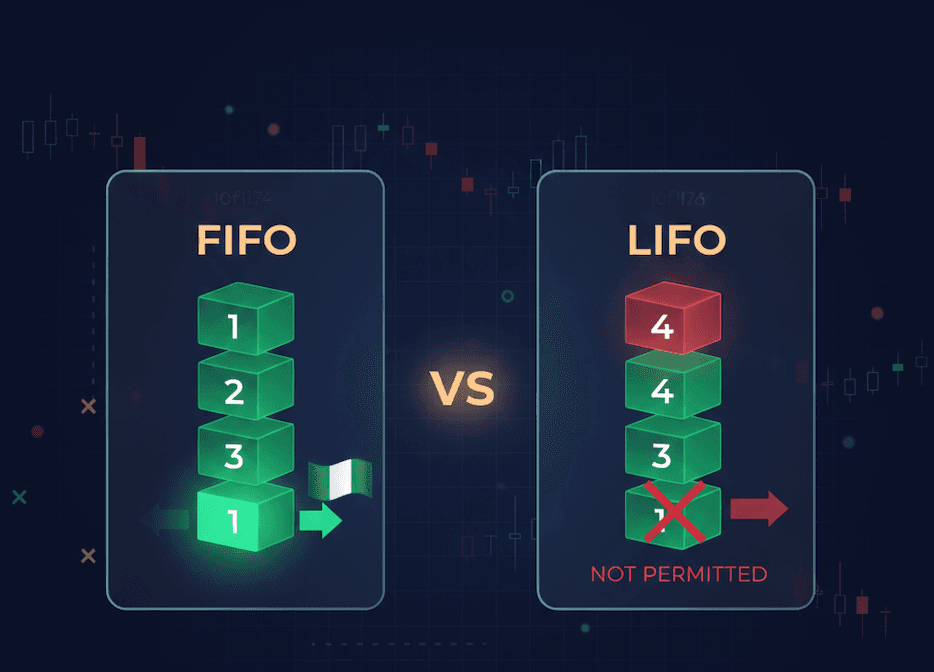
Under FIFO, the oldest shares you purchased are considered sold first. Think of it like a queue at a bank: the first person to arrive is the first person served. The first shares to enter your portfolio are the first shares to leave when you sell.
If you bought shares in three separate batches, January, April, and August, and then sold some in November, FIFO dictates that the January shares are sold first. Only after those are fully exhausted does the calculation move to the April batch, and so on.
This means your cost basis is built from your earliest (and often cheapest) purchase prices, which has direct implications for how much tax you owe.
LIFO Explained (Last In, First Out)
LIFO is the opposite approach: the most recently purchased shares are considered sold first. Picture a stack of plates: the last plate placed on top is the first one removed.
Under LIFO, if you sold shares in November, the calculation would start with the August batch (the most recent purchase), then move backwards to April, and finally to January if needed.
LIFO is used in some jurisdictions and can be advantageous in certain market conditions, particularly in rising markets where recent purchases have higher cost bases. However, LIFO is not permitted for securities transactions in Nigeria.
Why Nigeria Uses FIFO
Nigeria's tax authorities mandate FIFO as the required cost basis method for calculating capital gains on securities. The Nigeria Revenue Service (NRS) and the relevant provisions of the Capital Gains Tax Act require that taxpayers use FIFO when determining the cost basis for shares and other securities sold on the Nigerian market.
This is not a matter of preference or tax planning choice. Unlike some jurisdictions that allow investors to select their preferred method (such as the United States, which permits specific identification in certain circumstances), Nigerian tax law prescribes FIFO as the standard method.
The rationale is consistency and simplicity: FIFO provides a uniform, predictable basis for calculating gains across all taxpayers, reducing the scope for manipulation and ensuring that the tax treatment of securities transactions is straightforward for both taxpayers and the revenue authority.
For investors, this means there is no decision to make about which method to use. Every sale of securities must be calculated using FIFO, regardless of whether another method might produce a more favourable tax outcome.
Worked Example: FIFO in Action
Let us walk through a detailed example using Dangote Cement (DANGCEM), one of the most widely traded stocks on the Nigerian Exchange (NGX).
Building the Position
An investor accumulates DANGCEM shares over the course of 2025:
| Purchase Date | Shares Bought | Price per Share | Total Cost |
|---|---|---|---|
| January 2025 | 500 | ₦280 | ₦140,000 |
| April 2025 | 300 | ₦310 | ₦93,000 |
| August 2025 | 200 | ₦350 | ₦70,000 |
| Total | 1,000 | ₦303,000 |
The investor now holds 1,000 shares with a total cost of ₦303,000. The weighted average cost per share is ₦303 (₦303,000 / 1,000), but under FIFO, we do not use the average. Each purchase lot retains its own cost.
The Sale
In November 2025, the investor sells 600 shares at ₦340 per share.
Total sale proceeds: 600 x ₦340 = ₦204,000
Calculating Cost Basis Under FIFO
Under FIFO, the oldest shares are sold first. Here is how the 600 shares are allocated:
Step 1: The first 500 shares come from the January lot (the oldest purchase) at ₦280 each.
Step 2: The remaining 100 shares come from the April lot (the next oldest) at ₦310 each.
| Lot Used | Shares Sold from Lot | Cost per Share | Cost Basis |
|---|---|---|---|
| January 2025 (oldest) | 500 | ₦280 | ₦140,000 |
| April 2025 (next oldest) | 100 | ₦310 | ₦31,000 |
| Total | 600 | ₦171,000 |
Capital gain under FIFO: ₦204,000 - ₦171,000 = ₦33,000
What Would LIFO Have Produced?
For comparison (though this is not permitted in Nigeria), let us see what the result would have been under LIFO:
Under LIFO, the most recent shares are sold first:
Step 1: The first 200 shares come from the August lot (the most recent) at ₦350 each.
Step 2: The next 300 shares come from the April lot at ₦310 each.
Step 3: The remaining 100 shares come from the January lot at ₦280 each.
| Lot Used | Shares Sold from Lot | Cost per Share | Cost Basis |
|---|---|---|---|
| August 2025 (newest) | 200 | ₦350 | ₦70,000 |
| April 2025 | 300 | ₦310 | ₦93,000 |
| January 2025 (oldest) | 100 | ₦280 | ₦28,000 |
| Total | 600 | ₦191,000 |
Capital gain under LIFO: ₦204,000 - ₦191,000 = ₦13,000
The Difference
| Method | Cost Basis | Capital Gain | Difference |
|---|---|---|---|
| FIFO (required in Nigeria) | ₦171,000 | ₦33,000 | — |
| LIFO (not permitted) | ₦191,000 | ₦13,000 | ₦20,000 less gain |
Under FIFO, the taxable gain is ₦33,000, more than double what it would have been under LIFO. This is because FIFO uses the older, cheaper shares first, resulting in a lower cost basis and therefore a higher gain.
Key insight: In a rising market (where share prices increase over time), FIFO typically produces a higher taxable gain because you are matching the sale against your cheapest, earliest purchases.
FIFO with Multiple Sales: How Remaining Lots Carry Forward
After the sale of 600 shares described above, the investor's remaining position is:
| Lot | Shares Remaining | Cost per Share | Total Cost |
|---|---|---|---|
| April 2025 | 200 (300 bought, 100 sold) | ₦310 | ₦62,000 |
| August 2025 | 200 (none sold) | ₦350 | ₦70,000 |
| Total | 400 | ₦132,000 |
The January lot is fully exhausted. The April lot has been partially used. If the investor makes another sale, FIFO will continue from where it left off: the next shares sold will come from the remaining 200 shares in the April lot at ₦310, followed by the August lot at ₦350.
This lot tracking carries forward indefinitely. Every new purchase creates a new lot, and every sale consumes lots in strict chronological order.
Implications for Tax Planning
While you cannot choose a different cost basis method in Nigeria, understanding how FIFO works has real implications for how you manage your investments and tax liability.
In a Rising Market, FIFO Means Higher Gains
When share prices trend upward over time, your oldest shares have the lowest cost basis. Selling them first (as FIFO requires) produces the largest possible gain and therefore the highest tax liability. This is the most common scenario on the NGX for well-performing stocks.
In a Falling Market, FIFO Can Produce Higher Losses
Conversely, if a stock's price has declined over time, your oldest shares have the highest cost basis. Selling them first produces a larger loss, which can be valuable for tax-loss harvesting, using realised losses to offset gains elsewhere in your portfolio.
You Cannot Cherry-Pick Lots
Under FIFO, you have no discretion over which shares are deemed sold. You cannot strategically select a high-cost lot to minimise your gain. The order is always chronological, based on purchase date.
Purchase Timing Matters
Since every purchase creates a new lot that will eventually become the "first in" for a future sale, the price at which you buy today affects your tax position in future years. Buying at a low price creates a lot that will produce a higher gain when eventually sold under FIFO.
Holding Period Considerations
FIFO also affects holding period calculations. Since the oldest shares are sold first, they are more likely to qualify as long-term holdings, which may have implications for how your gains are categorised and reported.
How Journaira Handles FIFO Automatically
Tracking FIFO cost basis manually, across multiple stocks, multiple purchase dates, and partial sales, quickly becomes unmanageable with spreadsheets. A single error in lot allocation can cascade through all subsequent calculations.
Journaira automates the entire process:
- Automatic lot tracking: Every trade you import (via CSV or PDF from your Nigerian broker) is recorded as a distinct lot with its purchase date and price.
- FIFO cost basis calculation: When you record a sale, Journaira automatically allocates shares from your oldest lots first, exactly as NRS requires.
- Real-time gain/loss reporting: Your capital gains are calculated instantly, with a clear breakdown showing which lots were used and their individual cost bases.
- Remaining lot visibility: You can always see your current lots, their ages, and their cost bases, helping you understand the tax implications of a potential future sale before you make it.
- Dual threshold monitoring: Journaira tracks your gains against both the ₦150,000,000 proceeds threshold and the ₦10,000,000 gains threshold under the 2025 Finance Act, so you know exactly where you stand.
No more manual FIFO calculations. No more spreadsheet errors. Import your trades and let Journaira handle the rest.
This article is for educational and informational purposes only. It does not constitute tax advice, financial advice, or legal advice. Tax laws and regulations are subject to change. Please consult a qualified tax professional or financial adviser for guidance specific to your individual circumstances. Journaira is a trading journal and portfolio tracking tool — not a licensed tax or financial advisory service.