Dangote Refinery IPO: What ₦525 a Share Means for Your Portfolio, Your Taxes and Your Real Returns
The Dangote Refinery IPO opens September 14 at ₦525 a share, with a ₦5,250 minimum. What subscribing means for your capital gains tax, your dividends after withholding, your real returns at 15.43% inflation, and what to watch between allotment and listing.
A ₦5,250 Ticket to Africa's Biggest Share Sale
On Monday, September 14, 2026, the largest company ever to seek a listing on the Nigerian Exchange begins selling shares to the public. Dangote Petroleum Refinery is offering 4.1 billion shares at a fixed ₦525 each, and the minimum application of 10 shares costs ₦5,250. The offer closes on October 13, the shares are expected to list on the NGX in November, and the company is targeting ten million retail investors, which would make this the widest share-ownership drive in Nigerian history.
The scale is hard to place on the exchange it is joining. At the offer price, the refinery would list at a market value of ₦65.22 trillion, almost the size of the NGX's four largest companies combined: Airtel Africa at ₦23.68 trillion, Dangote Cement at ₦17.45 trillion, MTN Nigeria at ₦17.07 trillion and BUA Foods at ₦13.69 trillion, as those values stood in early September. BusinessDay has estimated the listing could lift the exchange's total market capitalisation toward ₦225 trillion, which would make one company roughly 29% of the entire market.
You do not need to rush. The window is thirty days, allotment is decided after the offer closes rather than first come, first served, and the application itself takes minutes on any approved platform. What deserves your time is everything the application screens will not show you: what this company earns and why, what a sale will one day do to your tax position, what 15.43% inflation does to the return you are hoping for, and what to write down before the listing so that next year you can judge the decision you actually made.
The Offer in Numbers
| Term | Detail |
|---|---|
| Offer price | ₦525 per share, fixed |
| Minimum application | 10 shares (₦5,250) |
| Offer window | September 14 to October 13, 2026 |
| Base offer | 4.1 billion shares (about ₦2.15 trillion) |
| Extra capacity | 15% over-allotment option, plus absorption of up to 30% of oversubscription, each subject to regulatory approval |
| Value at listing | ₦65.22 trillion (124.23 billion shares) |
| Expected listing | November 2026, Nigerian Exchange |
| Loyalty incentive | Up to 2 free shares for holding the minimum subscription through 12 and 24 months, subject to regulatory approval |
| Lead issuing house | Vetiva Advisory Services |
Two details in that table repay attention. First, the base offer is 4.1 billion shares out of 124.23 billion, so the public is being offered about 3% of the company. Even counting the private-placement investors who bought in at ₦490 in July, less than a tenth of the refinery will sit outside the Dangote and NNPC blocks: per the prospectus, Aliko Dangote's vehicles will control 84.34% after the offer, and the state oil company NNPC holds about 7%. Small free floats can support prices, because there is little stock to sell, and they can also concentrate power, because minority shareholders decide nothing. Both statements are true here.
Second, the loyalty incentive is smaller than the headlines suggest. Two shares are worth ₦1,050 at the offer price. Treat the bonus as a gesture toward patient holders, not as part of your return.
Subscribing Takes Minutes. The Decision Deserves Longer
The mechanics have been built for reach. Anyone with a Bank Verification Number and a bank account can subscribe through the approved digital channels, and press coverage has named around eighteen platforms, including Moniepoint, MTN MoMo, PiggyVest, Paga, Bamboo and Chapel Hill Denham, alongside receiving banks and licensed stockbrokers. If you do not have a CSCS account, one is created for you during the application, reportedly in about two minutes. Allotted shares land in that CSCS account after the offer closes; if you already trade through a broker, our comparison of Nigerian stockbrokers covers where those accounts live and what they cost.
Payment is made in full at application. If the offer is oversubscribed and your application is scaled back, the difference is refunded. The SEC has warned, repeatedly, that nobody legitimate is selling Dangote shares in a WhatsApp group or promising guaranteed allocation: applications go through the platforms and brokers named in the offer documents, and through nothing else.
That is the entire how-to. A dozen publications have printed the step-by-step guide; the rest of this article is about the questions the steps do not answer.
The Bull and the Bear Case, in Plain Naira Terms
The refinery's first half of 2026 was remarkable. Revenue reached ₦19.13 trillion in the half-year results published ahead of the offer, more than double the same period last year, with net profit of $1.82 billion (about ₦2.55 trillion) and EBITDA of $2.60 billion at 83.6% utilisation. That followed roughly $2 billion of combined losses across 2024 and 2025 while the plant worked through its start-up years.
The uncomfortable question is how much of the turnaround is the company and how much is the war. The Strait of Hormuz crisis is in its sixth month as this is written, Brent crude is above $100 a barrel, and strikes have repeatedly hit Gulf refining capacity. With competitors offline, a 700,000 barrel-per-day refinery on the Atlantic coast, outside every Middle East chokepoint, has been selling into a market desperate for products. Ship-tracking data from Kpler showed Dangote as Europe's largest jet fuel supplier, ahead of the United States, with a record 466,000 tonnes in June and more than 400,000 tonnes in July, when it supplied about a fifth of the continent's jet fuel imports.
The bulls argue that the advantages outlast the war: the geography is permanent, the plant is new, and an announced $14.3 billion expansion programme aims to double capacity to 1.4 million barrels per day before the end of the decade. Three research houses have published valuations above the listing value. The bears answer that you are being asked to pay a normal-times multiple on wartime earnings. The US Energy Information Administration expects Brent to average about $74 in 2027 as supply recovers, and refining margins would come down with it. A pre-offer caution piece in Nairametrics quotes analysts who put fair value near ₦324 a share on enterprise-value comparisons and project a dividend yield around 2%. There is also an earnings-quality footnote: Ecofin Agency reported that a $410 million first-half loss on external hedging was offset by a derivative held with Dangote Industries, a related party. Nothing in the disclosure suggests irregularity, but a sum close to a quarter of the headline profit flowed through an intra-group arrangement, which is worth knowing.
| Published view | Value | Against the ₦525 offer |
|---|---|---|
| Analysts quoted by Nairametrics (EV/EBITDA comparison) | about ₦324 per share | roughly 38% below |
| Offer price | ₦525 (₦65.22 trillion) | – |
| CardinalStone (12-month target) | ₦688.09 per share | about 31% above |
| Chapel Hill Denham (fair value; also a distribution platform for the offer) | ₦82.62 trillion ($62.53 billion) | about 27% above |
| Renaissance Capital (range) | $53.9 billion to $62.1 billion | about 9–26% above |
Dollar valuations are measured against the offer's value of about $49.4 billion at the ₦1,321/$ rate implied by Chapel Hill's paired naira and dollar figures.
A published range that runs from 38% below the offer price to 31% above it is not a sign that somebody is incompetent. It is what happens when the central question, how long do war margins last, has no knowable answer. Your subscription is, whether you frame it this way or not, a position on that question. This article will not pick a side for you; it will insist that you know which side you are picking, and that you write it down.
What the Dangote IPO Does to Your Tax Position
Start with the good news: subscribing is not a taxable event. You pay ₦525 per share and nothing else.
Dividends, when they come, carry 10% withholding at source. A ₦10,000 gross dividend arrives as ₦9,000. The company has said it intends to pay dividends in US dollars, funded by hard-currency export earnings, and that plan still needs approval from the SEC and the Federal Ministry of Finance. Until that approval exists, treat dollar dividends as an intention, not a term of the offer.
The tax that deserves real thought is capital gains tax on the day you eventually sell. Under the rules in force since the 2025 Finance Act, 30% CGT applies only when you cross two thresholds in the same period: more than ₦150,000,000 of total sale proceeds in a rolling twelve months, and more than ₦10,000,000 of total gains in the calendar year. Cross one and not the other, and the tax is ₦0. Both thresholds count every disposal you make, across your whole portfolio, not just one stock. Our complete guide to Nigerian capital gains tax works through the rules in detail; here is what they mean at three subscription sizes, assuming a future sale at CardinalStone's ₦688 target.
| Investor | Subscription | Sale proceeds at ₦688 | Gain | Thresholds crossed | CGT |
|---|---|---|---|---|---|
| Emeka, 100 shares | ₦52,500 | ₦68,800 | ₦16,300 | Neither | ₦0 |
| Funke, 10,000 shares | ₦5,250,000 | ₦6,880,000 | ₦1,630,000 | Neither | ₦0 |
| Chidi, 100,000 shares | ₦52,500,000 | ₦68,800,000 | ₦16,300,000 | Gains only | ₦0 |
Chidi's row is the one nobody writes about. His gain of ₦16,300,000 sails past the ₦10,000,000 gains threshold, yet he owes nothing, because his proceeds of ₦68,800,000 stay under the ₦150,000,000 proceeds threshold. The dual-threshold design shelters even large gains when the money involved stays below institutional scale.
Now change one fact. Suppose Chidi had also sold ₦100,000,000 of bank stocks earlier in the same twelve months, booking ₦2,000,000 of gains on them. His rolling proceeds become ₦168,800,000 and his calendar-year gains become ₦18,300,000. Both thresholds are now crossed, and the 30% applies to the entire ₦18,300,000, not just the excess above ₦10,000,000. The bill is ₦5,490,000. That cliff, where one additional sale converts a tax-free year into a 30% charge on everything, is the single most expensive surprise in the current rules, and it is why sequencing your disposals across tax years matters more than most investors realise. Gains that do become taxable are self-assessed, with filing due by March 31 of the following year.
Two housekeeping notes. Nigerian tax law requires FIFO, first in, first out, so your IPO shares will sit as a dated lot and any later purchases form separate lots, sold oldest-first; our FIFO guide explains why lot tracking decides your taxable gain. And the loyalty bonus shares, if approved, will arrive as their own small lots. Published guidance does not settle whether a bonus issue carries a zero cost or spreads your original cost across the enlarged holding; at ₦1,050 of value the difference is small, but record the lots separately either way.
The Inflation Hurdle Before You Make a Kobo
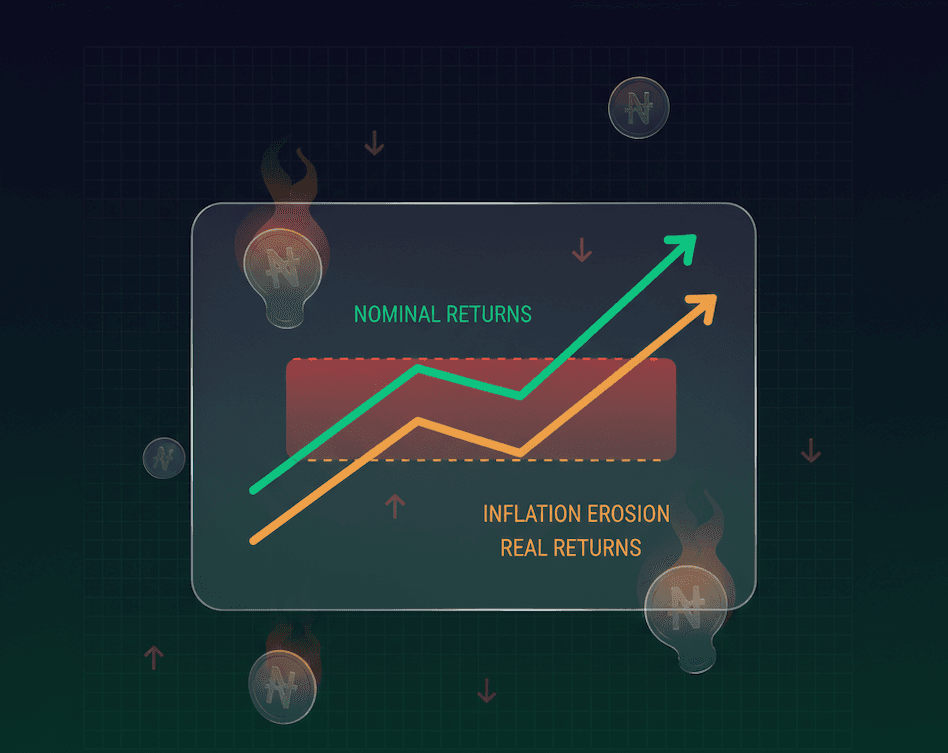
Headline inflation was 15.43% in July 2026, the latest NBS print, with food inflation at 20.31%. At that rate, ₦525 must become about ₦606 within a year for your purchasing power merely to stand still. Every naira of return below that is a loss wearing a gain's clothing, which is the argument our real returns guide makes at full length.
Run the offer through that lens, over one year, at July's inflation rate:
| Outcome after 12 months | Nominal return | Real return |
|---|---|---|
| Share stays at ₦525 | 0% | −13.4% |
| Share reaches ₦606 | +15.4% | 0% |
| Share reaches CardinalStone's ₦688 | +31% | about +13.5% |
| Bear case near ₦324 | −38% | about −46% |
The dividend does not rescue the arithmetic. If the projected yield near 2% materialises, it is 1.8% after withholding, against 15.43% inflation. What the dividend might offer instead is currency protection: paid in dollars, it would hold its value through naira depreciation in a way the naira-denominated share price may not. That is a genuine feature, and it is also, for now, an unapproved one. The investment case at ₦525 rests on price appreciation, and price appreciation has to clear 15.43% before it counts.
Allotment Risk and Position Sizing
Ten million investors chasing 4.1 billion shares is an average of 410 shares, about ₦215,250, per applicant if the base offer were split evenly. The July private placement was reported at 3.7 times oversubscribed, and the offer's extra capacity, the 15% over-allotment and the 30% absorption clause, exists because heavy demand is expected. If applications exceed supply, allocations are scaled back and the balance refunded; the binding basis of allotment will be published after the offer closes.
Three practical consequences follow. Do not assume a full allotment when you plan, because the position you get may be smaller than the one you applied for. Do not subscribe with money you need before December, because funds are committed from application until allotment and refunds are settled, and the shares themselves do not trade until the November listing. And size the position against the published range, not the headline: the table above runs from 38% below the offer to 31% above it, so a sensible test is whether your finances and your temperament survive the bottom of that range without a forced sale. A subscription that fails that test is too large, whatever you believe about the refinery.
What to Watch After You Subscribe
Between the close on October 13 and your first full year as a shareholder, five dates and decisions will tell you whether the thesis is tracking.
The basis of allotment, published after the offer closes, tells you what you actually own. The November listing tells you what the market thinks of ₦525, and the first weeks of trading will show whether July's placement investors, who paid ₦490, are holders or sellers. The SEC and Finance Ministry ruling on dollar dividends converts an intention into a term, or does not. The NBS inflation print for August, due mid-September while the offer is still open, resets the real-return hurdle before you even apply. And the oil market itself: any durable reopening of the Strait of Hormuz is the moment the wartime-margin question stops being hypothetical.
Then write down why you subscribed. Not a feeling, a number: the value you believed, the horizon you gave it, the range you accepted. A trading journal exists precisely so that next September you can audit the investor who made this decision, rather than defend whatever the price has since done.
How Journaira Helps
When allotment lands, log the position with its date and cost. IPO shares arrive as a CSCS credit rather than a broker contract note, so manual entry is the natural route for the allotment itself; later purchases and sales can flow in through the broker-agnostic contract note and CSV import. That single dated lot is the seed of every future tax calculation, because FIFO works from acquisition records, and the time to create them is when the facts are fresh.
Journaira's capital gains meters then track the two numbers this article kept returning to: your rolling twelve-month proceeds against the ₦150,000,000 threshold and your calendar-year gains against the ₦10,000,000 threshold. Before any future sale, of these shares or anything else, the meters show whether the sale stays inside the untaxed band or tips the year over Chidi's cliff.
And the inflation toggle keeps score honestly. It restates each position's return against live NBS data, so when the refinery's shares are up 20% nominal while inflation runs at 15.43%, the dashboard shows the roughly 4% you actually earned. That is the number to judge the IPO by, and the number to record beside the reasons you wrote down on subscription day.
The Bottom Line
The Dangote Refinery IPO makes buying shares easier than it has ever been in Nigeria: ₦5,250, a BVN and three minutes on an app. Ownership is the part that deserves work. The company earned extraordinary money in a wartime half-year; published valuations disagree by nearly seventy percentage points about what that is worth; the tax rules will treat most retail subscribers gently and punish an unplanned big-portfolio sale sharply; and 15.43% inflation sets a hurdle that a 2% dividend cannot clear alone.
None of that says subscribe, and none of it says stay away. It says know the size at which the bear case is survivable, know where your thresholds stand before you ever sell, measure the result in real terms, and write the thesis down while it is still yours. Start tracking your real returns, and the refinery in your portfolio will answer to the same standard as everything else you own.
This article is for educational purposes only and does not constitute financial advice. Investment decisions should be based on your individual circumstances, risk tolerance, and consultation with a qualified financial adviser. Past performance, whether nominal or inflation-adjusted, is not indicative of future results.